
In today’s hyper-competitive, AI-driven world, leaders face a stark dilemma. Do they pursue relentless efficiency, profitability, and market dominance – or lead with purpose, empathy, and soul?
This blog explores how to lead with soul without compromising strategic edge, using practical insights grounded in management consulting, leadership research, and my proprietary 4T model.
The truth is leading with soul is not a trade-off against strategic edge. In fact, when combined, they become a force multiplier for lasting impact and market leadership.
1. What Does Leading with Soul Really Mean?
Leading with soul is not about emotional softness or spiritual posturing. It is about anchoring leadership in purpose, meaning, and human connection, while driving strategic decisions with clarity.
Jim Collins (Good to Great) found that Level 5 leaders – those combining personal humility with professional will – build enduringly great organisations.
Harvard Business Review (2023) notes that authentic leaders who lead from their core values build greater psychological safety and outperform purely transactional leaders.
What core values or purpose do you want your leadership to radiate daily?
2. The Risk of Leading with Soul Without Strategy
While soulful leadership builds trust, purpose without strategic clarity risks:
- Inefficiency and financial instability
- Mission drift away from stakeholder needs
- Loss of market relevance
- Employee retention
- sustainability
Fast Company (2024) warns against purpose-washing, where companies claim soulful missions but fail to operationalise them strategically, leading to employee cynicism and reputational damage.
Purpose without strategy is wishful thinking. Strategy without purpose is soulless striving.
3. Integrating Purpose with Profit: The Strategic-Soul Balance
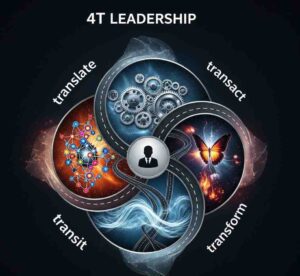 Using my 4T Consulting Framework, leaders can practically align soul with strategy:
- Translate:Convert your inner purpose into a clearly articulated vision aligned with market needs.
- Transact:Build offerings, business or organizational models, and exchanges that deliver value while staying rooted in your ‘why’.
- Transit: Adapt offerings and models continuously as market dynamics and societal expectations evolve.
- Transform: Create impact beyond profits, fostering institutional sustainability and societal contribution.
MIT Sloan (2024) highlights that human-centred leadership is a key strategic moat in the AI era, as it cannot be replicated by algorithms.
4. Embrace ‘Both/And’ Leadership
Wendy K. Smith & Marianne Lewis (2022) propose “Both/And Thinking” – holding creative tensions rather than choosing trade-offs.
In every decision, ask:
- Does this align with our purpose and soul?
- Does this strengthen our strategic market position?
Leaders who do this build resilient, adaptive organisations.
5. Embed Empathy into Strategy
Empathy is not opposed to strategic execution; it enhances it.
Daniel Goleman shows that leaders high in emotional intelligence outperform peers in strategic decisions, change management, and team performance.
Rasmus Hougaard & Jacqueline Carter (2022) demonstrate that compassionate leadership builds trust while enabling difficult decisions to be executed effectively.
Use stakeholder empathy mapping in strategic planning to keep decisions human-centred.
6. Measure What Matters: Soul + Strategy Metrics
Integrate purpose metrics with financial and operational KPIs:
KPIs:
- Employee well-being and engagement indices
- Customer trust and loyalty scores
- Social/environmental impact measures
- Profitability, market share, EBITDA growth
McKinsey (2022) found that companies with embedded purpose outperform peers in innovation and employee satisfaction by 30–40%.
It is important to develop a Balanced Scorecard combining ‘Soul Goals’ with strategic goals to keep leadership teams aligned.
7. Build a Culture That Sustains Both
Culture operationalises leadership intent. To build a soulful yet strategic culture:
- Recruit and reward based on purpose and performance alignment
- Share stories of decisions made with soul that achieved strategic success
- Facilitate team reflections on purpose and strategic clarity regularly
Deloitte (2024) reports that 77% of Gen Z and Millennials prefer organisations with clear societal impact integrated into business strategy.
8. Adaptive and Regenerative Leadership for the Future
Leading with soul while sharpening strategy is the new imperative:
BCG Henderson Institute (2023) recommends Adaptive Purpose – enduring at its core but flexible to market contexts.
Laura Storm & Giles Hutchins (2022) advocate where organisations actively enhance ecosystems and communities while remaining strategically strong.
This attracts top talent, loyal customers, and purpose-driven capital.
Leading with soul is not a threat to strategic edge. It is the lever that creates significance alongside success.
Where does your leadership tilt today – more towards soul or strategy?
How can you recalibrate to lead with both, starting this week?
Call to Action
If you want to translate your leadership purpose into strategic initiatives that drive measurable outcomes and lasting impact, explore my Strategic Soul Leadership Clarity Call.
“Purpose without strategy is wishful thinking. Strategy without purpose is soulless striving.”
Elias Moses is a Senior Business Strategist, Business Consultant, Researcher, Corporate and Leadership Coach, Orator, Columnist and an Entrepreneur. He is the founder and Director of ManagingNext and Manovsis
The author can be contacted@
email: elias@managingnext.in, linkedin: www.linkedin.com/in/eliasmoses