
“Working with a sense of purpose is a competitive advantage. Leading with it? That’s transformative.”
— ManagingNEXT
Let me begin with a quiet conversation that still echoes in me.
One CEO, who had just closed a Series C funding round, told me quietly during our debrief:
“We’re winning on paper, Elias. But I’m not sure if I’m inspiring anyone anymore — including myself.”
That sentence echoed louder than all the growth charts we’d reviewed that day.
And it speaks to a profound leadership crisis emerging today — one that’s less about strategy and more about soul.
“Am I still being followed… or just being obeyed?”
The Quiet Crisis No One Talks About
 Leadership today isn’t struggling with intelligence.
It’s struggling with integrity in visibility — the alignment between what’s deeply believed and how it’s daily expressed.
According to Gartner (2023):
- While 65% of employees want to work for a purpose-led company,
- Only 29% believe their leader consistently lives that purpose.
That’s a 36% credibility gap.
McKinsey’s global leadership study (2023) adds:
- 70% of professionals define their sense of purpose through work
- Yet, only 18% of executives say their leadership consistently reflects that purpose
And here in India, a Deloitte India survey (2023) shows:
- Only 1 in 5 leaders receive formal support on purpose-led leadership
- While 72% say it impacts team morale, trust, and retention significantly
So what’s causing the disconnect?
In a world flooded with automation, AI-generated communication, and algorithmic precision, leadership has all the tools to act —
but is forgetting how to authentically show up.
Purpose Is Not Philosophy. It’s a Strategic Advantage
 Let’s cut the fluff.
Purpose is not a poster on the boardroom wall.
It’s strategy in soul form — that invisible force that guides decisions under pressure,
holds culture during crises, and aligns action with aspiration.
Harvard Business School (2022) found that companies with strong purpose alignment:
- Outperform peers by 30–40% in times of disruption
- Experience up to 50% higher employee engagement
A PwC Global Talent report (2023) revealed:
- Purpose-driven companies attract 4x more leadership applications
- Experience 50% faster onboarding success at the C-suite level
In India’s hybrid leadership reality, where leaders are managing distributed teams, ethical scrutiny, and digital overload —
purpose isn’t idealistic. It’s existential.
Case Studies: Purpose-Led Leadership in Action
Satya Nadella | From Engineer to Empath
When Satya Nadella became CEO of Microsoft in 2014, the company was stagnant — brilliant but bureaucratic.
He reframed its core around a simple purpose:
“To empower every person and every organization on the planet to achieve more.”
The outcome?
- Microsoft’s stock surged over 800% under his leadership
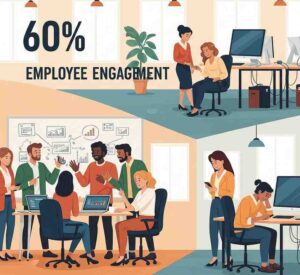
- Employee engagement rose by 60% globally (Microsoft Annual Report, 2023)
- Innovation velocity doubled, and internal collaboration soared
Nadella didn’t bring a new business model.
He brought a new presence — quiet, clear, and purpose-fueled.
Yvon Chouinard | The Patagonia Shift
The founder of Patagonia gave away his entire billion-dollar company to fight climate change.
This wasn’t branding. This was belief — in motion.
- Following the announcement, brand trust rose 22% (Forbes, 2023)
- Employee loyalty and applications increased by 34% within two quarters
This is the power of purpose as presence — when leaders become the message.
Narayana Murthy | Purpose Over Personality
In India, Infosys wasn’t built on flash or force.
It was built on Murthy’s unshakeable commitment to integrity, transparency, and stakeholder focus.
- Infosys ranks in the top 3 most trusted Indian IT brands
- Leadership retention is 38% higher than industry norms
Murthy didn’t lead with flamboyance. He led with clarity and credibility.
From Vision to Visibility
Here’s the hard truth:
You don’t need a new vision. You need to live your existing one more visibly.
Presence is not about charisma.
It’s about alignment — between inner compass and outer behavior.
This is where most leadership coaching fails.
They teach tools.
But what leaders need is a translation system — something that connects purpose to presence, presence to influence.
The 4T Framework: From Inner Clarity to Outer Credibility
 At ManagingNEXT, we don’t sell answers.
We help leaders become the answer — consistently, credibly, and purposefully.
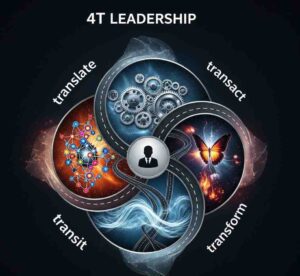
That’s why I developed the 4T Framework™ — a proprietary leadership system that:
✅ Translates personal purpose into practical leadership tone
✅ Transforms clarity into repeatable trust signals
✅ Aligns thinking, timing, tone, and touchpoints into a cohesive presence
✅ Equips leaders to thrive in the AI era, where attention is fleeting but trust is priceless
The 4T Framework is not about performance.It’s about presence that performs.
Elias Moses is a Senior Business Strategist, Business Consultant, Researcher, Corporate and Leadership Coach, Orator, Columnist and an Entrepreneur. He is the founder and Director of ManagingNext and Manovsis
The author can be contacted@
email: elias@managingnext.in, linkedin: www.linkedin.com/in/eliasmoses